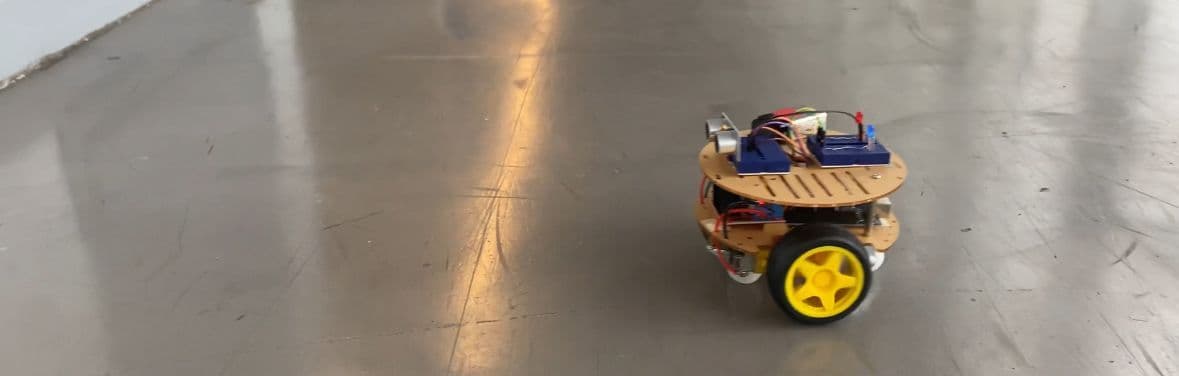
Two wires and a sign
Valentino Braitenberg's vehicles are a sensor wired almost straight to a motor: no controller, no memory, no model of the world. Wire the sensor to the motor on its own side and the vehicle flees the stimulus. Cross the wires and it charges at it. Invert the sign, so the sensor slows its motor instead of driving it, and the same machine now turns toward a source and comes to rest facing it.
His point is the asymmetry he called uphill analysis and downhill invention: building a behaviour is trivial, and recovering the mechanism by watching it is not. Someone who sees a vehicle settle beside a lamp reports affection, and is in fact describing a wiring diagram. The names in the next section are deliberately the observer's names, not the mechanism's.
| Robot | What is wired to what | Closest vehicle |
|---|---|---|
| Shy | One distance sensor inhibits both motors, and the inhibition grows as the object gets nearer | Vehicle 1, sign inverted |
| Explorer | Distance past a threshold triggers a turn on the spot, then forward again | Vehicle 2a in effect, avoidance |
| Aggressive | Distance past a threshold drives both motors harder, straight at the object | Vehicle 2b, aggression |
| Light-following | The photoresistor on the brighter side slows the motor on its own side, so the robot yaws toward the light | Vehicle 3a, love |
| Offended | Turns away once, then latches and refuses to resume | None, it needs memory |
| Adolescent | A timer rotates between explorer, offended and aggressive | None, no vehicle has a clock |